The unnoticed shift
For the first time in a long while, I have felt genuinely immersed in a turning point. Since joining Berger-Levrault, I have watched from the front row a transformation that is moving faster than most people perceive and that is redrawing the rules of the labour market and the economy right in front of those who are not yet looking. Every day we are reshaping our methodologies, processes, products and roles, with the sense of fleetingness and uncertainty of someone setting out on a new course with neither map nor compass, but with the certainty that standing still is the worst option. Amid this whirlwind of accelerated change, I have managed to carve out a few moments after months of frantic work to write down these reflections, which I hope will be of interest.
Those of us in direct and constant contact with every advance in AI tend to believe that everyone else lives inside the same bubble, but that is a mistaken perception. A simple coffee with friends or a family dinner is enough to realise that the diffusion of AI’s capabilities is still far from its real potential. Much of my immediate circle still thinks of AI as a chatbot, a kind of supercharged Google useful for making the occasional meme, polishing emails, answering legal or health questions, producing translations or solving a homework exercise — but still riddled with hallucinations and with a response quality that supposedly sits at the level of that famous Will Smith eating spaghetti video.
Far from it, we are immersed in a radical shift in processes and a disruptive wave that is shaking the foundations of the modern economic system — built on digital economies — a wave that many people are missing and whose quiet phase threatens to be shorter, with a more uncertain and widespread awakening than previous technological tides.
Many experts pointed to 2025 as the year of agents. What actually happened is that the agentic revolution kicked off at the very end of the year more abruptly than anticipated, flowing into a vertiginous 2026 in which progress reshapes the landscape almost daily. Overnight, those of us working with AI noticed a remarkable leap with the arrival of new models with superior agentic capabilities — Opus 4.5, GPT-5.2 — and the popularisation of orchestrators such as Claude Code and Codex, which had already been on the market but had gone unnoticed because earlier models lacked the capabilities to exploit them. Suddenly a phase shift occurred. We moved, abruptly, from erratic copilot-assisted generation systems to pseudo-autonomous flows with continuous verification and learning. It was not a gradual transition; it was a jump in speed and a vast window of possibilities that opened all at once.
First disruption: the value of software
Traditionally, the value of software rested on time and knowledge. Its real worth came from the fact that building a competitive tool required an enormous number of hours, deep technical expertise and a capital base almost no one could muster. That inevitably led us to economies of scale: companies concentrating that qualified and specialised talent, infrastructure and capital to amortise the huge cost of development across hundreds or thousands of customers. As a user, it was a clear decision: for a reasonable amount of money, you offloaded the entire technical and financial burden onto a third party that took care of keeping the tool up to date, solvent and competitive.
The first great disruption is that, all of a sudden, the tables have turned on the value of software. Access to and the capacity to generate software have been democratised; the technical moat has been bridged by an immediacy that reduces the value of these solutions to the bare minimum. The gap that once made in-house development unfeasible has evaporated thanks to the speed and knowledge that AI injects into every line of code. With near-zero marginal cost, business knowledge in the hands of the consumer and exponential model improvement, dependence on traditional providers is collapsing and shaking their business models to the core.
SaaS is in critical days. Today the value of code itself is almost residual; what matters are factors that until now were considered complementary: expertise, deep understanding of customer needs and support. The future is no longer defined by a technical inability to build the tool — the major constraint so far — but by the convenience of contracting something and forgetting about all the things nobody talks about beyond development itself (deployment, functional knowledge, hosting, assistance, consulting and implementation, cybersecurity…). In a world where software is abundant, value shifts from ownership of the product to integral management of the service.
Second disruption: roles
The second great disruption takes place in roles. That historical border between development and product teams has blurred almost to the point of disappearance. In today’s paradigm, value has shifted towards hybrid technical-functional profiles that combine advanced business knowledge with enough technical understanding to orchestrate solutions. It is a profile whose gap with respect to the pure technical specialist has narrowed dramatically thanks to AI. We are no longer looking for experts in closed silos, but for cross-functional architects in teams where business domain knowledge is the main compass.
Interestingly, this shift has rebalanced a scale that was always unfair. Historically, the functional profile was the most exposed link because replacement was easier in the labour market and because it lacked the defensive technical moat that protected the developer. Today the tables have turned. While AI still shows more shortcomings on the functional side than on the technical side, pure execution has become a commodity. In this scenario, the ability to understand the business object and to guide that superhuman agent that AI has become turns out to be the most valuable asset along the entire chain.
Inequality in access to opportunities
A consequence of this paradigm shift is a significant increase in inequality of access to opportunities: juniors will have an ever harder time breaking into new positions, since low-value-added tasks are already being done by AI, while more senior profiles are initially reinforced, taking on the supervision, validation, architecture and expertise tasks that have not yet been fully channelled into AI. Even so, they must adapt to this new reality, which demands a move away from operational execution and towards a more strategic focus. Failing to embrace this new reality — clinging to contempt for AI-generated code or insisting that deep technical knowledge will always be required to get the most out of these tools — is a stance that grows less tenable by the day and that can lead to professional obsolescence.
Being an AI specialist is not the answer either. Yesterday’s intricate techniques for squeezing the most out of models are being simplified at a frantic pace. The ephemeral roles that appeared only months ago — AI Engineering, prompting experts and the like — have practically disappeared. The raw intelligence of the models has devoured the need for those intermediaries, making it clear that technical mastery is no longer a refuge but a baseline that is now taken for granted.
The return of common sense
In a scenario of nearly unlimited capabilities, we need — paradoxically — something that is not abundant: common sense. When technology makes it possible to generate software massively and almost for free, the real virtue is knowing how to navigate the abundance. The challenge is no longer to build, but to bring the product home: adapting it to the real needs of the market without falling into a parade of options that overwhelm the user. Resisting excess and focusing on a product that is simple, intuitive and useful — one that stands out among the flood of alternatives that will inevitably appear, and that is designed to facilitate that service layer where real value is generated. Business knowledge and good judgement — things that sound so simple and yet remain the hardest asset to find.
A personal reflection
I write these lines from the incredible experience of these months co-leading projects that have gone through a remarkable transformation in both processes and products. I find myself in a state of expectant curiosity about where all this is heading. In our industry it is common to say that it is impossible to keep up, but the growth curve is now simply beyond grasp: it is taking the exponential shape of a sigmoid function, and keeping pace with the daily advances is just not possible. I spend almost as much time staying up to date as I do working on the projects themselves, and even so I feel I am losing milestones along the way.
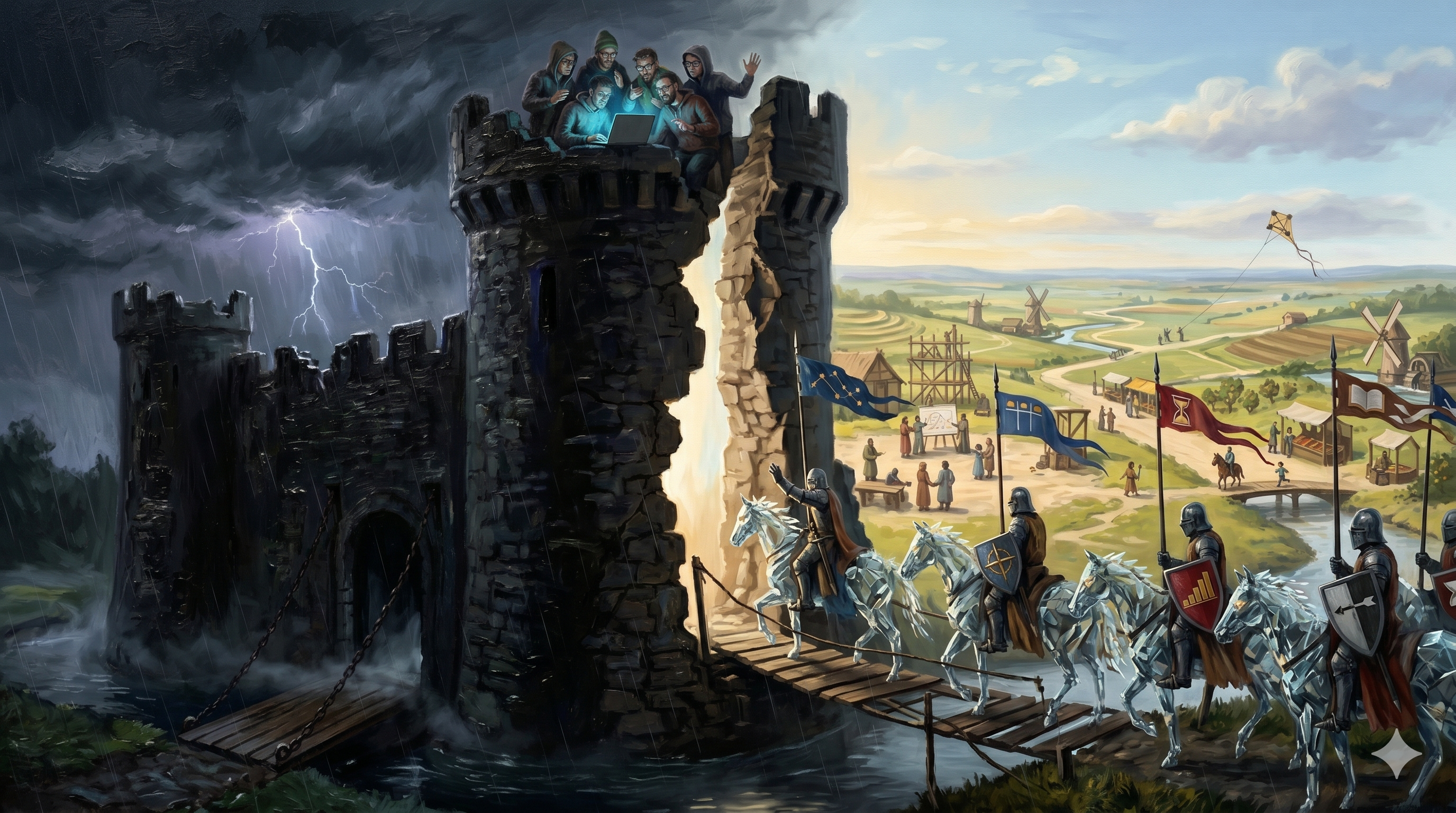
I cannot help feeling concern about the immediate impact on the labour market. I see roles misaligned with the current reality and positions that have become obsolete overnight. I am particularly worried about the resistance to change from those who remain entrenched in the old keep, defending a privileged position within a system that has already crumbled.
In the medium term, I am convinced that we are heading towards a total shift in the economic paradigm and the social contract. My hope is that the transition will not be as grim as it looks and that we will be capable of steering this technological leap towards collective benefit, rather than letting it merely widen an inequality that is already alarming.