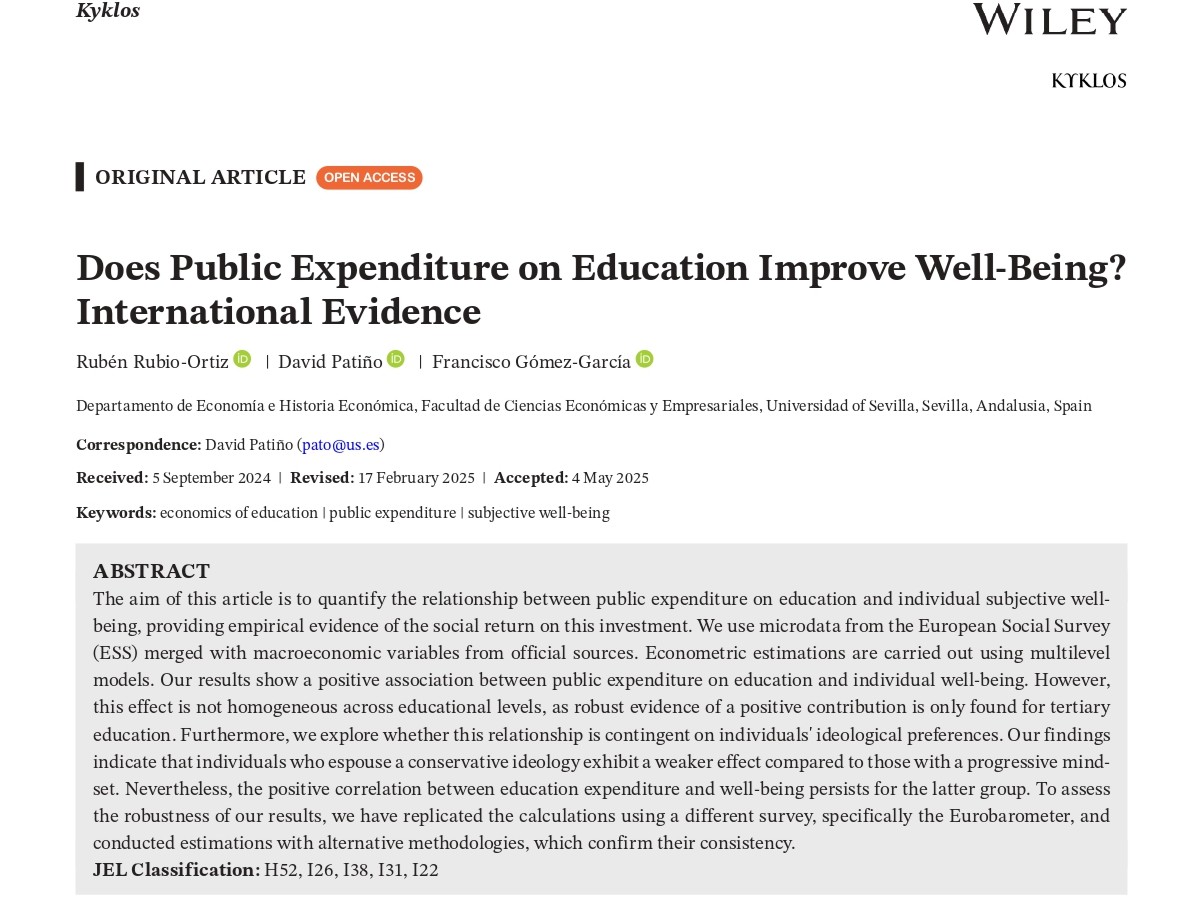
Does Public Expenditure on Education Improve Well-Being? International Evidence
Last month I received one of the best pieces of news in my academic life! My first scientific paper has been accepted for publication. On a personal level, it was a moment of immense joy and pride, because, as many of you know, the journey has not been an easy one. Since I started my doctorate, I have had to balance it with my full-time job, juggling to find time for family and friends. This is where I want to acknowledge the effort, contributions, and support of my co-authors, David Patiño and Paco Gómez, without whom this paper would not have been possible.
The journey of this paper has been long. Although it grew out of a master’s dissertation with great potential, it required deep methodological adaptations and a review process that lasted over a year and a half.
Taking advantage of the fact that this is my personal blog, I’d like to share with you my approach to scientific publishing and some interesting details that do not appear in the paper itself.
What Was the Research Aiming For?
I have always liked to argue that the purpose of the paper was to obtain a non-monetary assessment of the social return on public expenditure in education. You might ask what this adds relative to measurements of individual or social returns from human capital theory, which quantify the marginal return per year or monetary unit invested in education. Let me try to unpack this in the following paragraphs.
The Relationship Between Education and Well-Being
When we analyse the relationship between education and personal well-being, intuition leads us to think that it is always positive — and indeed, many studies confirm this. That is, it is generally assumed that a higher level of education translates into greater individual well-being, measured through life satisfaction or subjective well-being. This can happen through a direct impact (higher cultural and cognitive level) or an indirect one (better jobs, higher income, even better health). However, there is empirical evidence pointing in the opposite direction: in some cases, a higher level of education may be associated with lower well-being. Why?
One reason frequently cited is frustrated expectations. In general, a person invests in education expecting to obtain a better job, higher income, or social recognition. Yet the reality is that many of these people feel deeply frustrated when those expectations are not met. This can lead to a strong sense of dissatisfaction and frustration, negatively impacting their subjective well-being. A tangible reflection of this situation can be found among many young people in Spain today, who face labour markets saturated with a highly qualified labour supply, precarious wages, and a disproportionate rise in the cost of living, leading them to question whether the effort and sacrifice of years of study was really worth it.
On the other hand, education has high costs that often go unnoticed. We are not only talking about direct expenditure (tuition, books, accommodation), but also the enormous opportunity cost of not working during the period of study. With the current bachelor’s-plus-master’s structure, this period can be up to five years, implying an estimated income loss of between €80,000 and €100,000 (considering a salary between the minimum wage and the average for young people aged 25 to 30). Given that the wages of young people with university degrees are not much higher than those of the population with lower levels of education, it may take several years for the gap to close, so the return on investment is diluted.
In addition to these costs, education also introduces a certain health cost, especially mental health, in certain groups — such as students from low-income families who face performance pressure for scholarships, or who cannot afford to fail because they would not have a second chance, or in highly competitive academic environments.
Finally, a third component is that the jobs associated with that training can in some cases involve greater stress, a heavier workload, or even greater responsibility. This can lead to a deterioration in subjective well-being, as the person may feel overwhelmed by the demands of the job, counteracting the expected benefits of education.
The Social Lens
Given all of the above, one might expect the relationship to be identical whether viewed from an individual or social perspective. However, this would be falling into the fallacy of composition. At the social level, the relationship becomes more complex. Although part of the population may experience lower individual well-being, this does not necessarily translate into lower satisfaction for society as a whole.
The population as a whole may benefit from the positive impacts and externalities of education: technological advances, innovation, a qualified population in key areas such as healthcare or education, and higher levels of productivity. And this can happen even without translating into greater direct well-being for the individuals who generate those benefits.
Why Well-Being?
First, for methodological reasons. Overall satisfaction, used as a proxy for experienced utility, is a holistic approach that encompasses effects beyond the monetary and which are difficult to measure in those terms (such as health, social context, or culture). It also allows us to capture both direct effects and the indirect channels through which education affects people’s lives. By offering a global response that is apparently not directly linked to the objective of the study, strategic behaviour in responses is avoided and a net, comprehensive assessment of all factors affecting individual well-being is obtained.
Second, and this is a more personal observation: I conceive of money, social recognition, and cultural level as means to an end — happiness. But not happiness as a fleeting or hedonistic feeling, but in a eudaimonic sense: a state of personal satisfaction and fulfilment. In this context, happiness becomes the ultimate goal, the supreme objective. Although it is a heterogeneous objective with a high degree of subjectivity, a universal foundation can be created for the general well-being of the population to increase. It is about going one step further, not stopping at the means.
Findings
In the paper we demonstrate that public expenditure on education has a positive effect on the well-being of the population. However, the effect is not homogeneous across educational levels. Specifically, the only level with a positive and significant effect is expenditure on tertiary education. By contrast, expenditure on primary and secondary education has no significant effect on well-being.
This could be due to several reasons. On the one hand, in Europe — the geographical scope of the study — primary and secondary education is universally extended with a relatively high level of quality, so it is likely that the marginal effect of each additional monetary unit invested is saturated, meaning the population does not perceive an increase in well-being from additional increases in expenditure. This is not the case for tertiary education, which still has considerable room for improvement in access and still provides some differentiation in the labour market, so the population does perceive an increase in well-being from increases in expenditure. On the other hand, the externalities of tertiary education that go beyond human capital formation — such as research spillover effects, innovation, social capital, or cultural dynamism — may be more perceptible to the population, which could explain the positive effect on well-being.
Furthermore, the effect is not homogeneous across segments of the population. We demonstrate that the population that tends to position itself more ideologically conservative experiences a smaller, though still positive, effect than the population with a more progressive ideology. These nuances are important, especially when additional variables such as income level, age, etc. are included, as they allow public spending policies to be tailored to optimise the effect on the population.
Future Lines of Research
One of the main limitations we encountered is the availability of aggregate data at an international level. Most of these studies are involuntarily skewed towards developed countries, which have official data sources and wide availability.
It would be very interesting to investigate whether these patterns observed in European countries are maintained in developing countries, where primary and secondary education are not yet universalised and public expenditure on tertiary education is very limited.
In addition, having panel data would allow us to use an even more robust methodology, but for now, data availability is what it is.
Where Can It Be Read?
The paper has been published in the journal Kyklos, in Open Access, thanks to funding from the University of Seville, and can be found at the following link: You can read it openly here
Audio Summary
I am sharing an audio podcast-style summary of the paper, generated by Google NotebookLM: Listen to my audio summary here